
Your Funding Runs the AI Engine: How and Why It Pays Back
When you fund a subscription on Dialect Library, you're not paying for a black box. You're funding a real, running AI infrastructure -- and you're only ever...
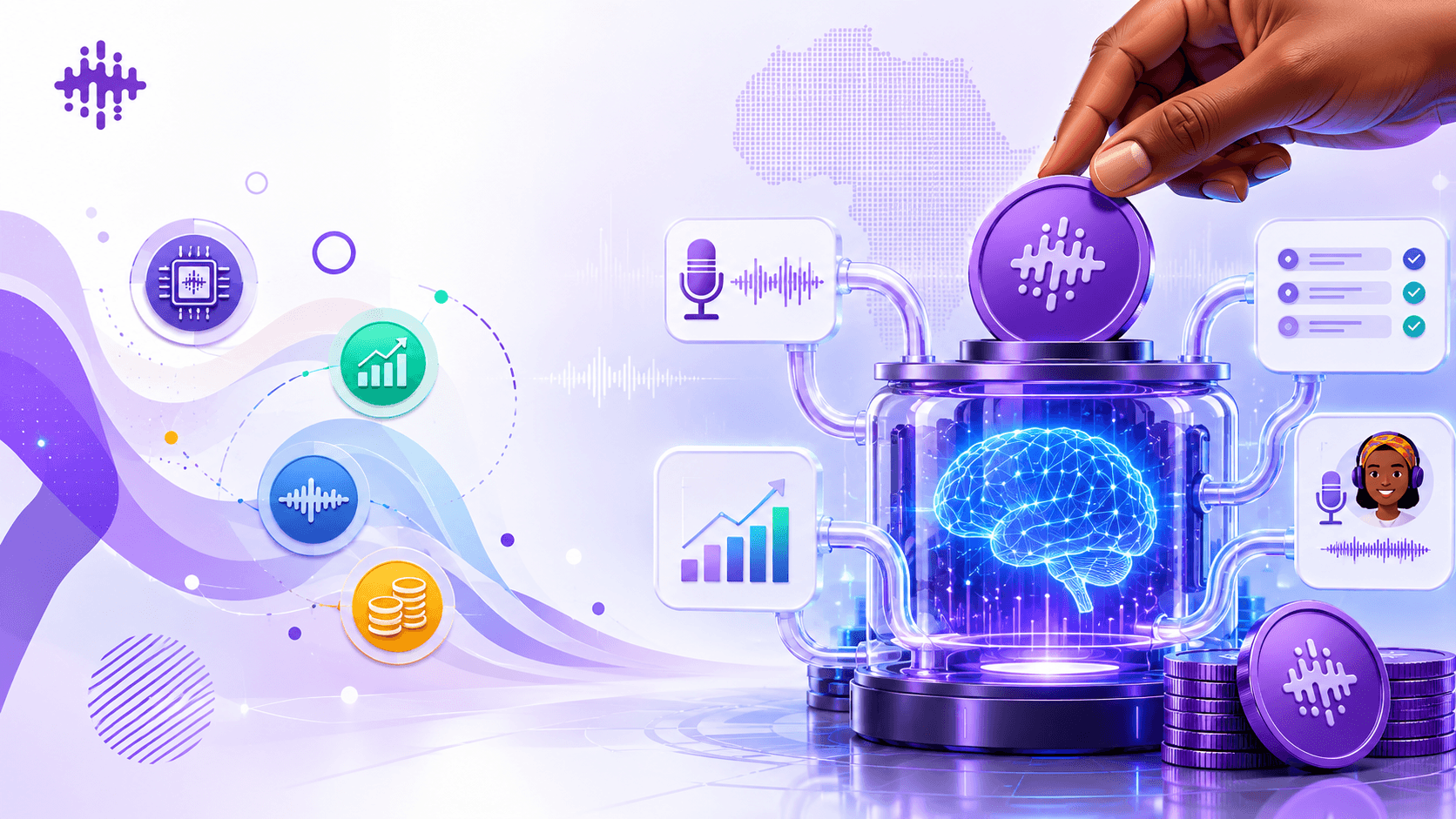
When you fund a subscription on Dialect Library, you're not paying for a black box. You're funding a real, running AI infrastructure -- and you're only ever billed for work that's actually been done and verified. Here's exactly how that works, and why it's built this way.
What your funding actually pays for
Every dialect recording, transcript, and translation on the platform passes through a real pipeline of infrastructure before it ever reaches you. That pipeline isn’t free, and it doesn’t run itself:
- GPUs and compute -- speech-recognition models need real processing power to turn a raw voice recording into an accurate transcript, at scale, across many dialects at once.
- AI models -- purpose-built automatic speech recognition (ASR) models for African and global dialects, kept running and available on demand.
- CPU and orchestration -- the systems that route every submission through quality checks, transcription, and scoring, reliably and in the right order.
- Tremendous storage -- every audio clip, transcript, and translation is stored securely so the dataset stays available, auditable, and reusable.
This is infrastructure that has to run continuously, whether or not any single submission ends up being useful. Someone has to pay for that -- and we've built the platform so that cost is covered fairly, by the people actually using the output.
You pay for what's real -- not just any recording
Here's the part that matters most: your subscription doesn't bill you for raw audio sitting in a queue. It bills you for work that has actually cleared the pipeline -- meaning it's been processed, transcribed, and scored.
- A recording that fails quality checks (too noisy, too short, unclear) never reaches you, and you're never billed for it.
- A recording only counts once it’s been transcribed by our AI models and scored -- either through consensus with other trainers’ submissions on the same prompt, or through peer reverse-validation.
- You're paying for verified, usable dialect data -- not for effort, and not for noise.
That's the core principle: quality-gated, scored data in, fair billing out. Nothing gets billed on a promise -- only on a result.
Why we automate the processing
Manually reviewing every recording that comes in wouldn't scale, and it would introduce delay and inconsistency into something that needs to be fast and fair. So we automate the entire pipeline end to end:
- A trainer submits a recording.
- It’s automatically checked for audio quality before anything else happens.
- Our AI models transcribe it.
- It’s scored -- either against other trainers’ submissions of the same prompt, or via a peer’s reverse-validation.
- Only once it clears scoring does it become part of the dataset your subscription draws on.
Automation is what makes it possible to guarantee this at scale, consistently, without human bottlenecks slowing down either the trainers earning on the platform or the subscribers relying on the data.
How billing connects back to quality
Your subscription funds a pool that pays trainers for verified work. That connection is direct and intentional: the better and more complete the verified data your subscription draws on, the more accurately your billing reflects real value delivered -- not estimates, not guesses, not raw uploads.
In short: the infrastructure is expensive to run, and it runs continuously. Your subscription is what keeps it running -- but you're never paying for idle compute or unscored recordings. You're paying for language data that's been through the full pipeline: quality-checked, transcribed by real AI models, and scored for accuracy.
Why this matters for you
- Fair to you: you only pay for output that has cleared quality and scoring -- not for storage of unusable audio.
- Fair to trainers: the same pipeline that protects your billing is what makes sure trainers get paid for real, accurate work.
- Sustainable for the platform: funding tied to verified output means the GPUs, models, and storage keep running, and the dataset keeps growing.
That's the model: real infrastructure, real automation, and billing that only ever reflects real, verified work.